Post-Dated Cheque (PDC) Tracking: The Complete Guide for Indian Businesses
By Pranit Muttha, Founder & CEO · 19 July 2026 · 8 min read
Key Takeaways
- A PDC is legally deposit-restricted until its written date — depositing early gets it bounced by the bank, not just the party.
- Every register entry needs a status field (pending/deposited/cleared/bounced) and a due-date view — most paper registers skip both.
- Section 138 of the Negotiable Instruments Act gives strict deadlines after a bounce: present within 3 months, send a demand notice within 30 days, then a limited window to file.
- A 10-minute weekly routine (review, deposit, reconcile, follow up) prevents almost all missed deposits.
Why PDCs Are the Riskiest Paper in Your Drawer
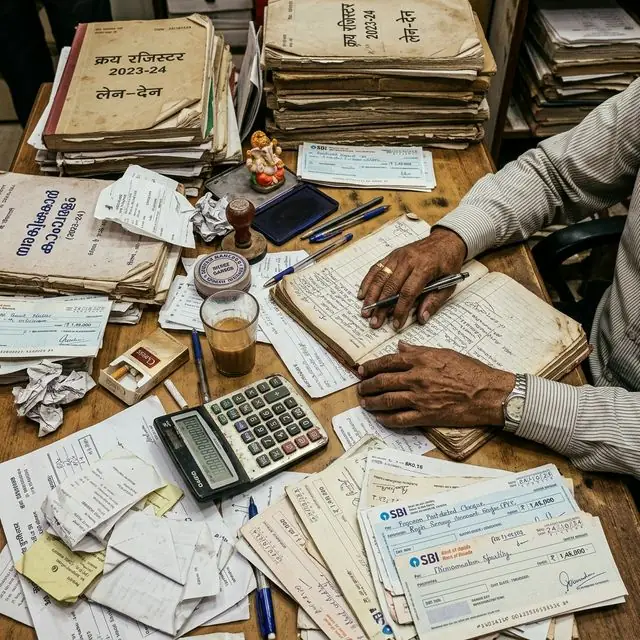
Post-dated cheques are the backbone of credit in Indian wholesale trade — hardware, grain, cloth, building materials, FMCG distribution. A supplier ships today; you hand over a cheque dated 45 days out. Simple. Until you are holding thirty of them across a dozen parties and four banks.
- Missed deposits: a cheque forgotten in the drawer past its validity means chasing the party for a fresh one — awkward and slow.
- Bounced cheques: depositing before confirming the party's balance triggers bounce charges and damaged relationships.
- No visibility: you cannot answer "how much money is arriving next week?" without flipping through paper.
- Disputes: without a register, "humne cheque diya tha" arguments have no evidence.
What a Proper PDC Register Must Capture
Whether you keep it in a notebook or an app, every cheque entry needs: party name, cheque number, bank and branch, amount, cheque date (the date it becomes valid), received/issued date, purpose or invoice reference, and current status — pending, deposited, cleared, bounced, or returned.
The two fields most paper registers miss are status and due-date visibility. A register that cannot answer "what is due this week?" at a glance is a record, not a system.
The Legal Side: Cheque Bounce Basics
Under Section 138 of the Negotiable Instruments Act, a bounced cheque for a legally enforceable debt is a criminal offence — but the process is deadline-driven: present the cheque within its validity (3 months), send a demand notice within 30 days of the bank memo, and file within the prescribed window if payment is not received. Miss a date and your legal position weakens. This is exactly why serious traders keep a dated, timestamped record of every cheque event.
Quick Answers: PDC Meaning & Validity
What does "30 days PDC" mean?
A "30 days PDC" is a post-dated cheque written today but dated 30 days ahead — the receiver cannot legally deposit it before that date. It is a common short-credit term in wholesale trade: goods move now, payment is committed for a fixed date instead of on the spot.
How do you check if a PDC is valid before depositing?
- Confirm the cheque date has arrived — banks reject cheques presented before their date.
- Check the cheque is within its 3-month validity window from the date written on it.
- Verify the amount in words and figures match, and the signature is present.
- Call or message the party a day before depositing to confirm sufficient balance — this single step prevents most bounces.
Paper vs Digital PDC Tracking
A paper register works until volume grows. Then the failure modes stack up: no reminders, no backup, no multi-person access, no proof trail. A digital cheque register gives you due-date timelines, status at a glance, party-linked history, and records that survive fire, loss, and staff churn. We covered the broader shift in From Bahi Khata to the Cloud.

A Simple Weekly PDC Routine (10 Minutes)
- Monday morning: review all cheques due in the next 7 days; confirm with parties whose balance is doubtful before depositing.
- Deposit day: mark cheques as deposited the same day — status discipline is everything.
- Friday: update cleared/bounced status from your bank statement; follow up bounces immediately with a written note.
- Month-end: reconcile the register against your party khata so receivables and cheques tell one story.
In Muttha Finance, this routine is built in: every cheque links to its party khata, staff can log cheques with controlled permissions, and the audit log records every status change — evidence you can rely on in a dispute.
Start Tracking PDCs Digitally — Free 30-Day Trial — Log your first cheque in 2 minutes. No credit card required.