The Best Khatabook Alternative in India for 2026 (Honest Comparison)
By Pranit Muttha, Founder & CEO · 20 April 2026 · 9 min read
Why Shopkeepers Search for a Khatabook Alternative
Khatabook changed Indian business. Before it, traders were carrying around red registers and updating udhar entries by hand. Khatabook digitized that — and for millions of small shops, it was a genuine improvement. Credit where it's due.
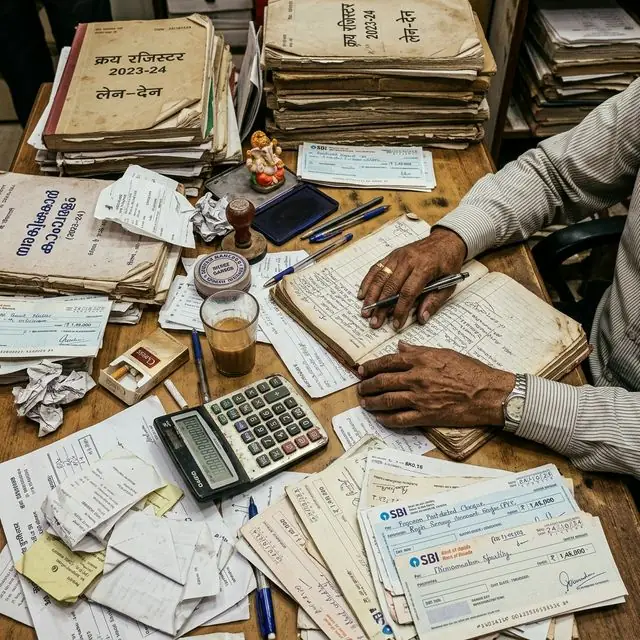
But here's what happens as your business grows: you open Khatabook and realize you need more than a digital udhar register. You need daily income and expense entries. You need to track post-dated cheques across 30 suppliers. You need your accountant and three staff members to access the books simultaneously. You need a tamper-proof audit log to know if any entry was edited.
And Khatabook — for all its strengths — was not built for that. That's the honest truth. If you're a growing wholesale trader, distributor, or multi-staff retail operation searching for a Khatabook alternative in India in 2026, Muttha Finance has a plan built exactly for your scale.
Key Takeaways
- Khatabook and Muttha Finance both handle party-wise udhar tracking well — that's the baseline, not the differentiator.
- Khatabook has no post-dated cheque tracking, no daily income-expense ledger, and no staff audit log — gaps that matter once a business grows past a handful of customers.
- The switch makes sense once you deal in PDCs, have 2+ staff posting entries, or manage 20+ parties across different credit cycles.
- Muttha Finance starts at ₹499/month with a 30-day free trial — no credit card, no installation.
Khatabook vs Muttha Finance: What Actually Matters
Let's be specific. The goal isn't to say Khatabook is bad — it isn't, for what it does. The goal is to help you understand whether it covers what your business actually needs.
📒 Party Ledger / Udhar Khata — Both Do This
Both Khatabook and Muttha Finance let you maintain party-wise credit and debit entries. You can track who owes you and who you owe. This is the baseline — and both handle it well.
📋 Daily Income & Expense Ledger — Only Muttha Finance
Khatabook is primarily a credit/debit tracker between parties. It does not give you a full daily transaction ledger — income from multiple sources, expense categories, opening and closing balance per day. Muttha Finance's daily entry ledger does exactly this, with category-wise breakdowns, month and range views, and exportable reports.
💳 Post-Dated Cheque (PDC) Tracking — Only Muttha Finance
If you deal in cheques — and most wholesale traders do — Khatabook offers zero support. Muttha Finance's cheque register lets you log every PDC (issued and received), track status (pending / cleared / bounced), and get notified before deposit deadlines. Missing a single cheque can cost you a client — this feature alone pays for the subscription.
🔒 Staff Access Controls & Permissions — Only Muttha Finance
Khatabook has limited multi-user support. Muttha Finance was built for teams from day one. You can invite staff, set role-based permissions (what each person can see and edit), and keep admin-only sections locked. Read more about staff management with access controls.
🛡️ Tamper-Proof Audit Log — Only Muttha Finance
Every action in Muttha Finance is logged — who added, edited, or deleted an entry, and when. This is critical for businesses with multiple staff. Khatabook does not offer this. Muttha's audit log is your protection against staff fraud and accidental data changes.
🗂️ Digital Document Vault — Only Muttha Finance
Bills, invoices, GST documents, scanned cheques — Muttha Finance lets you store and organize all important business documents securely in the cloud. Khatabook has no equivalent feature.
Who Should Switch from Khatabook to Muttha Finance?
Khatabook is fine if you're a micro-retailer with a handful of regular customers and no staff. The moment any of the following is true, you need more:
- You deal in post-dated cheques — hardware traders, grain merchants, cloth wholesalers, building material suppliers
- You have 2+ staff who need to add entries independently
- You want a daily P&L — not just who owes you, but your total business cash flow
- You've experienced staff tampering with records or had discrepancies you couldn't trace
- You manage 20+ parties — suppliers and customers across different credit cycles
- You store important documents (contracts, GST returns, invoices) and need them accessible digitally
In short: if you've outgrown a pure udhar app, Muttha Finance is the next step. According to the Ministry of MSME Annual Report 2024, Indian MSMEs that digitize core accounting operations see measurably faster credit access and supplier reliability. The tools you use are a signal to your entire business ecosystem.
Other Khatabook Alternatives You May Have Considered
For completeness, let's look at what else is out there — and where each falls short for serious business users.
Vyapar App
Vyapar is strong on invoicing and GST billing. If billing and invoice generation is your primary need, it's worth considering. However, it lacks the party khata depth, PDC tracking, and audit log that wholesale traders specifically need. It also carries a steeper learning curve and pricing for smaller businesses. See Vyapar's features and compare for your own use case.
OkCredit
OkCredit is similar to Khatabook — a simple udhar tracker for small retailers. It's even more limited in scope. No daily ledger, no cheque tracking, no document vault. It's designed for micro-businesses, not growing wholesale operations.
myBillBook
myBillBook is a strong GST billing and invoicing app with good inventory tracking — a fair pick if invoicing is your main need. But like the others here, it is not built around the party khata: no dedicated PDC tracking and no tamper-proof audit log for staff entries. See our full myBillBook alternative comparison.
Tally
Tally is powerful but complex and desktop-only. Setup requires an accountant, licensing is RS 18,000–54,000 upfront, and mobile access is limited. For shopkeepers and traders who want something that works from a phone on day one, Tally is overkill. Muttha Finance gives you 80% of what growing traders actually need, at 10% of the cost and complexity.
How Does Muttha Finance Pricing Compare?

Muttha Finance starts at ₹499/month — that's less than ₹17 per day. Khatabook's premium plan is comparable in price, but delivers a fraction of the features for wholesale and distribution businesses. See all Muttha Finance plans — including the 30-day free trial.
There's no installation, no per-device fee, no accountant required to set it up. You register, add your shop name, invite your staff, and start entering transactions in under 5 minutes. The trial requires no credit card.
According to RBI's digital payments report, small businesses that adopt structured digital accounting tools reduce month-end reconciliation time by an average of 40%. At ₹499/month, Muttha Finance pays for itself the first time it helps you catch a missed cheque deposit.
Ready to Try the Best Khatabook Alternative?
If you've been using Khatabook and feel like you've hit its ceiling — or if you're evaluating options for the first time — Muttha Finance is the upgrade built specifically for Indian wholesale traders, distributors, and multi-staff retail businesses.
Start Your Free 30-Day Trial — No credit card. No installation. Works on mobile and desktop. Setup in 5 minutes.